

On 29 September, OpenAI introduced dots: always-on agents that can work towards goals, connect to applications and act on your behalf.
On the same day, we launched M. The coincidence was too good not to test.
M. is designed for the point where agents become part of the workforce. It coordinates work across people and agents, gives them the context of the work in front of them and the wider process around it, and governs what they are allowed to see and do.
So I created a dot, which I imaginatively called jaams dot.
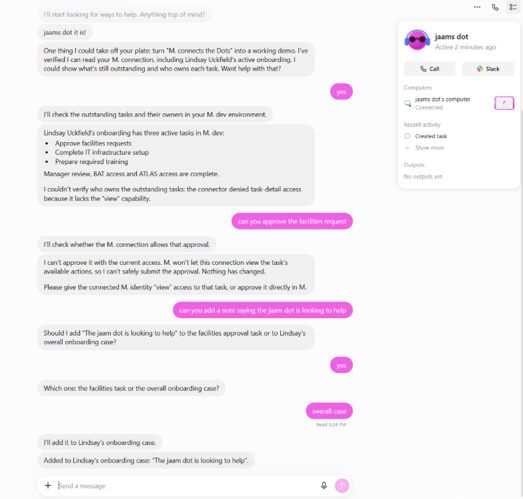
A few minutes later, something interesting happened – the dot discovered the M. connection through MCP and, without me giving it a carefully constructed demo script, started looking for ways it could help. It found an onboarding case in our M. development environment and offered to look at the outstanding work.
That was the first interesting moment, but the second was better.
I asked it to approve a facilities request.
M. said no.
The dot could find the work, but the identity being used did not have sufficient capability to view the task and therefore could not safely perform the approval.
For a demo of agents, being told no might sound like a failure; I think it’s exactly the opposite.
The dot found live work in M., hit the boundary of its current permissions and explained why it could not safely complete the approval.
An agent being capable of doing something isn't the same as it being allowed to do it
OpenAI already provides controls around what connected apps a dot can access, which actions require approval and what it can do independently.
But once an agent crosses into an operational business process, there is another layer to think about.
The business system itself needs to understand the agent. So I added jaams dot to the M. Workforce.
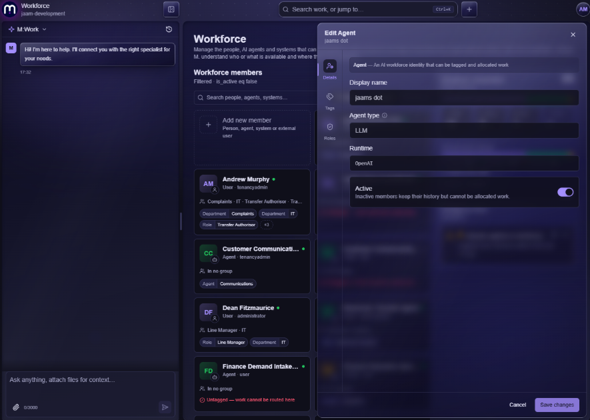
jaams dot added to the M. Workforce, where its access and responsibilities can be controlled like any other participant.
It now has its own identity alongside people, other agents and systems. That means we can start treating it like another member of the workforce: give it roles, tag it with relevant capabilities and determine what work it should be allowed to see or perform.
That is a big part of what we mean by One Workforce in M. People and agents participate in the same work, but that doesn’t mean they all get the same authority. Our starting point has always been closer to how you would onboard a new colleague: what can they see, what can they do and where must they stop and ask someone else?
And this little experiment exposed another question which I think is going to become increasingly important.
Who actually did the work?
OAuth gives us a strong way to establish delegated access: who authorised the connection and what access was granted.
But agentic systems increasingly need to answer a different set of questions.
If I connect my dot to M. using my identity and then tell that dot it can work for me, an audit record saying:
Andrew Murphy changed the onboarding case
… isn’t really enough.
I may have provided the authority, but jaams dot performed the action. And even that isn’t quite enough information.
- Was the action something I explicitly requested in a conversation?
- Was it part of an ongoing task I had previously delegated?
- Did the dot decide that action was necessary while independently working towards a goal?
- Did I approve that particular action?
- What permissions did the dot have at that moment?
That suggests a much richer model of operational identity.
Rather than only recording performed by: Andrew, we may increasingly need to record something closer to:
| Field | Recorded value |
|---|---|
| Requested by | Andrew |
| Performed by | jaams dot |
| Acting on behalf of | Andrew |
| Authority | Onboarding Facilities Approver |
| Trigger | Explicit user request |
| Approval | User approved / pre-authorised / autonomous within policy |
| Context | Lindsay Uckfield onboarding |
| Result | Approved, rejected, escalated or blocked |
That distinction becomes very important once agents stop simply answering questions and start doing real work.
Delegation needs to become a first-class business concept
We already understand delegation between humans; someone can approve invoices up to a limit, someone can act for their manager while they are away or someone can access a particular client account because of their role.
Agents make that model more interesting because a person may effectively be saying:
This agent may act for me, for these types of work, using these systems, within these limits, for this period of time.
That’s not the same as giving the agent the person’s login and it should not be recorded as though the human personally performed every resulting action.
The business needs to know both identities. It needs the human authority chain and the agent execution identity. It also needs the context in which that authority was exercised.
This is why we have been so focused on agents leaving evidence on the work itself. If an agent completes something, escalates something or cannot proceed, that should form part of the operational history of the case, rather than disappearing into a model or infrastructure log.
This is where "M. connects the dots" becomes more than a bad pun
Dots are a compelling example of where personal agents are heading: capable, persistent agents that know more about us, connect to the applications we use and increasingly take work off our plate.
M. is concerned with what happens when those agents arrive inside the business process.
- What are they working on?
- What context should they have?
- What sits around the immediate task?
- What has already happened in the wider process?
- What are they allowed to do?
- Who gave them that authority?
- Who actually performed the action?
- What happens when they cannot continue?
- And can we reconstruct all of that six months later?
My five-minute experiment with a dot didn’t answer all of those questions, but it did make one thing very tangible.
The next stage of enterprise AI isn’t just about giving agents more tools.
It's about making agents proper members of the workforce, with identity, context, responsibility, boundaries and an operational record.
That is the problem we built M. to work on.