M. is the Context Engine and Agentic Work Management platform that brings people, AI agents, applications and systems together to run end-to-end business processes.
At its heart is a simple idea: the work itself should remain connected, even as the people, technology and AI involved in delivering it change.
Inside M.
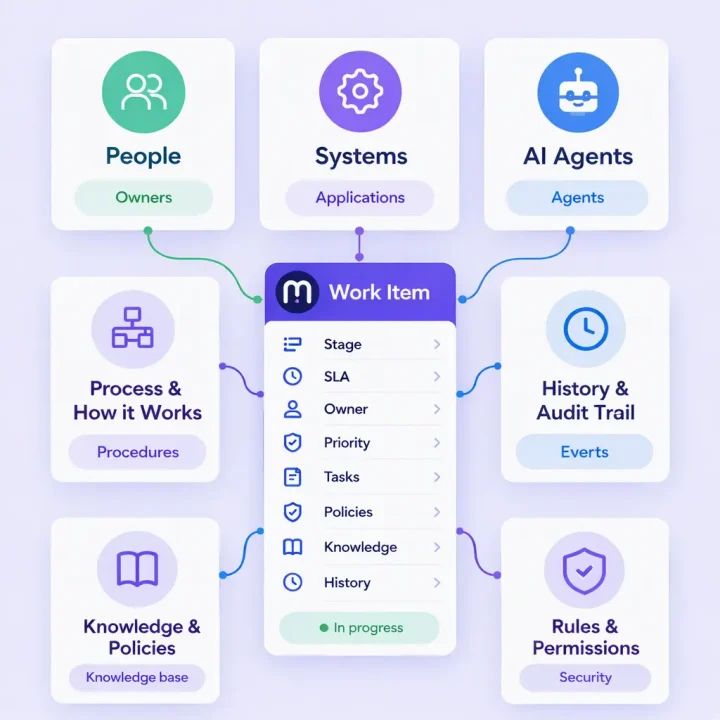
M. provides a common operating model for that work – bringing together process, ownership, live activity, organisational context, knowledge, controls and history. People and AI agents can then participate in the same work, using the applications and experiences that make most sense for them.
That gives organisations a foundation for running work today, while progressively introducing more AI and autonomy tomorrow.
A Context Engine for Agentic Work Management
AI can only make good decisions when it understands the world in which those decisions are being made.
M.’s Context Engine brings together the information surrounding business activity: how a process should work, where the live work is now, who is responsible for it, the knowledge and policies that apply and the history of what has happened before.
At the centre of this is the Workitem – a persistent, live representation of a piece of work. A Workitem maintains its state as work progresses, including stages, tasks, responsibilities, context, rules, permissions, SLAs and history. It can continue over hours, days or longer, even as different people, agents, applications and systems participate.
That matters in an agentic world. Instead of giving AI the context of a single conversation, M. gives it the context of the actual work.
One process. Many ways to participate.
The people completing a business process shouldn’t all have to work in the same application – and neither should AI.
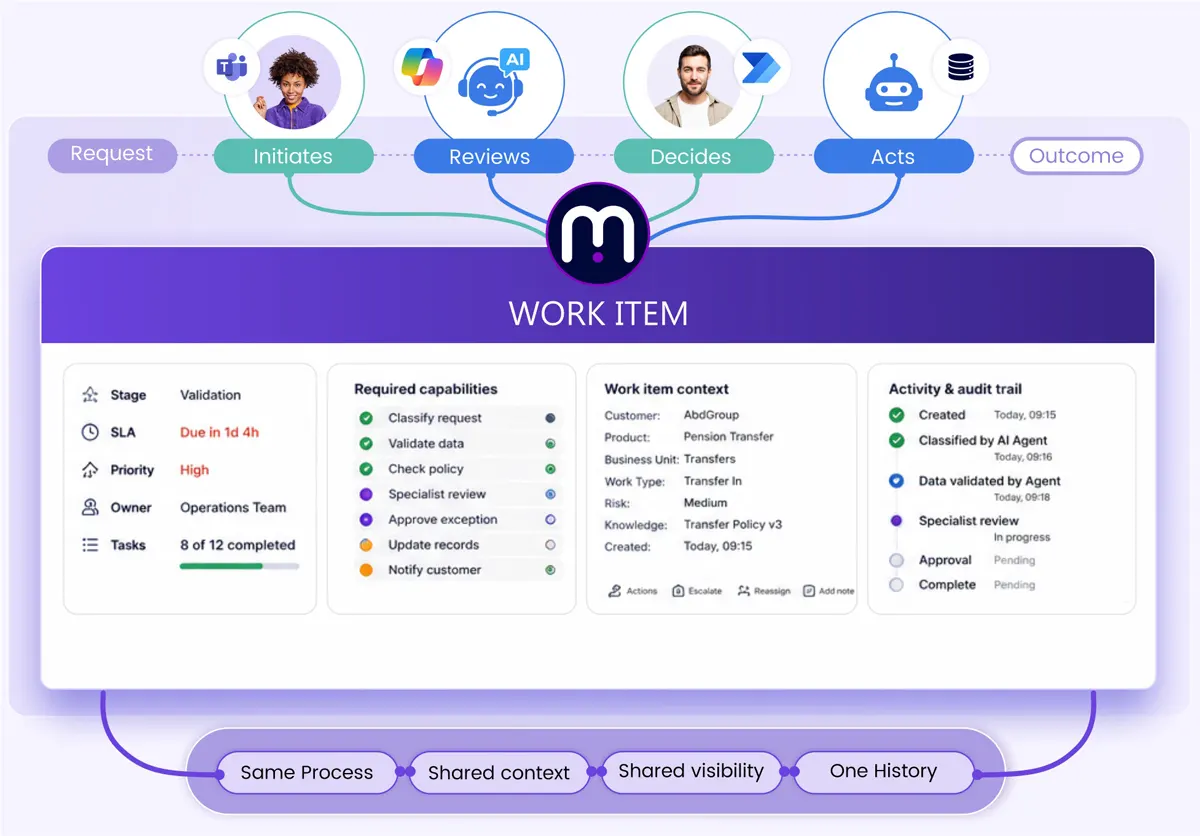
With M., the business process is separated from the experience used to interact with it. An employee might work through Microsoft Teams. A specialist could use a Power App or purpose-built application. Another user might work directly in M. A Microsoft agent could perform a defined activity, while an M. agent monitors the wider process and a connected business system completes another action.
Underneath those different experiences sits the same M. Workitem, maintaining the state, context, responsibilities and history of the work from beginning to end. So, when the experience changes, the process doesn't have to be rebuilt around it.
Built on Microsoft
Microsoft technology is at the core of M.
M. is built on Microsoft Azure and uses Microsoft capabilities across its architecture, including Azure application, identity, AI, messaging, data and communication services.
Its built-in AI capabilities use models deployed through Microsoft Foundry, while Microsoft Entra ID provides the enterprise identity foundation for people, applications and services.
Additionally, M. is designed to help organisations make more of the Microsoft technology they already have – bringing capabilities such as Microsoft 365 Copilot, Copilot Studio, Foundry, Teams, Power Platform, Dynamics 365, Work IQ and Microsoft agents into end-to-end business processes.
Azure AI
Copilot
Power Platform
AI Foundry
Microsoft Teams
Office 365
Microsoft provides powerful specialist capabilities.
M. provides the Context Engine and Agentic Work Management model that connects the work across them.
Make more of your Microsoft investment
Most organisations don’t need another technology island – they need the technologies they already use to work together more effectively, particularly as AI becomes part of everyday operations.
M. enables Microsoft capabilities to participate where they add the most value.
A Power App might provide a specialist user experience over one part of a process. Power Automate can handle integrations and automated actions. Employees can interact with M., managed work through Teams or Copilot. Agents created in Copilot Studio or Foundry can take responsibility for defined activities. Dynamics and other enterprise systems can continue to provide specialist applications and data.
M. maintains the wider process around them – its state, tasks, ownership, context, knowledge, rules, SLAs, permissions and history.
M. gives the Microsoft ecosystem a shared operational context in which to work.
AI built in from the start
AI Built In
Organisations don't need to build a large estate of AI agents before they can start getting value from M. - M. has its own AI capabilities built around the work itself.
Work. Only better.
Using M. can help teams analyse existing processes and information, build the operating model, support people as they perform live work, identify risks and bottlenecks and find opportunities to improve how processes run.
Context built in
Because M. agents understand the M. Workitem natively, they can work with the live state, tasks, knowledge, context, SLAs and history surrounding a process and as organisations become more confident with AI, external agents can join that same workforce and take responsibility for more defined areas of work.
Bring your own agents
M. isn't a closed AI environment.
Any agent. One process.
Microsoft agents built using Copilot Studio or Foundry – alongside agents created using other frameworks – can participate in M.-managed processes alongside people, applications, systems and M.'s own agents.
Agents act securely
Through M.'s Model Context Protocol (MCP) server and APIs, external agents can discover the tools available to them and perform permitted actions against live work.
Controlled by design
Crucially, connecting an agent doesn't give it free rein. Microsoft can continue to provide the surrounding enterprise identity, authentication, security, connectivity and data controls, while M. governs what that participant is allowed to see and do within the business process.
The result is AI that can act – but within defined operational boundaries.
Built for developers. Understandable by the business.
M. gives the business ownership of how work should operate without restricting how technology teams build around it.
Developers can create complete applications using their preferred frameworks, services, user experiences and architecture while M. provides the repeatable work platform underneath.
That means development teams don’t have to rebuild process state, tasks, workforce, context, permissions, history and agent participation every time they create another business application.
M. is designed to be used programmatically through REST APIs, events, webhooks and MCP, making it possible to build custom applications, Microsoft-led experiences, agent-led solutions, or a combination of all three, around the same underlying work.
The business owns the work. Technology teams build around it.
AI-ready doesn't mean AI-only
M. is designed for where organisations are going, without assuming they are already there. A process can begin entirely human-led, using familiar rules, tasks, responsibilities and SLAs.
AI can then start by supporting people – finding information, summarising cases, recommending actions or identifying risks. Agents can progressively take responsibility for defined activities, while people continue to handle decisions, exceptions and areas requiring human judgement.
Over time, more of the work can become autonomous where the organisation has the confidence, context and controls to support it.
The underlying M. model remains the same throughout. You can run from manual through AI-assisted and agentic to increasingly autonomous.
Start wherever you are today.
Governed and observable by design
As AI takes responsibility for more work, organisations need to know more than what an agent can do, they need to understand what it is doing.
Because people, agents, applications and systems participate against the same model of work, M. maintains the operational history around their contribution.
Organisations can see who or what performed work, where responsibility sits, what happened, where intervention is needed and how the balance between human and AI activity is changing.
That turns AI adoption from an experiment happening somewhere inside the technology estate into something that can be understood in the context of real operational performance.
One platform that gets smarter as work happens
Every Workitem creates more than an outcome, it creates operational history.
Decisions, actions, exceptions, hand-offs, outcomes and performance become part of the organisational context that M. can use to help people and agents understand work and identify what could improve next.
That creates a continuous cycle: understand the process, run the work, learn from what happens and use that evidence to improve what happens next.
As models change, agents evolve and new applications arrive, the underlying work remains connected.