

There’s a lot of conversation about what AI can do for businesses.
We talk about agents that can complete tasks, make decisions, find information and increasingly take on whole chunks of work that previously needed human intervention.
However, there’s a fairly fundamental problem sitting underneath all of that. AI can only make good decisions if it understands what’s going on and in most organisations, that context is scattered all over the place.
It lives in systems and documents, in processes and policies, in emails and conversations and, perhaps most importantly, in the heads of the people who understand how the business actually works.
And this is why we believe context is going to become one of the most important foundations for the next generation of AI in the workplace.
A conversation isn’t the same as a business
Most of us have already experienced AI that understands the context of a conversation. Ask a question, add some information, ask another question and the AI remembers what you’ve been talking about. All very useful, but workplace AI needs something much richer.
If you want an AI agent to participate meaningfully in real business processes, it needs to understand more than the task immediately in front of it. It needs to know how that process should run, who is responsible for what, what rules apply, what has already happened, what exceptions have occurred and what decisions have previously been made.
In other words, it needs the context of your business, not just the context of a conversation. Without that, even a very capable AI is operating with one hand tied behind its back.
Context connects the dots
Think about a good employee who has worked in your organisation for several years. Part of what makes them valuable isn’t just that they know how to complete individual tasks, it’s that they understand how everything connects. They know which customer needs particular attention, why an unusual approval route exists, when something should be escalated and what happened the last time a similar situation arose. They have, drum roll please, context!
If AI is going to become genuinely useful within operational work, it needs access to that same kind of organisational understanding and this is the thinking sits at the heart of M. by jaam.
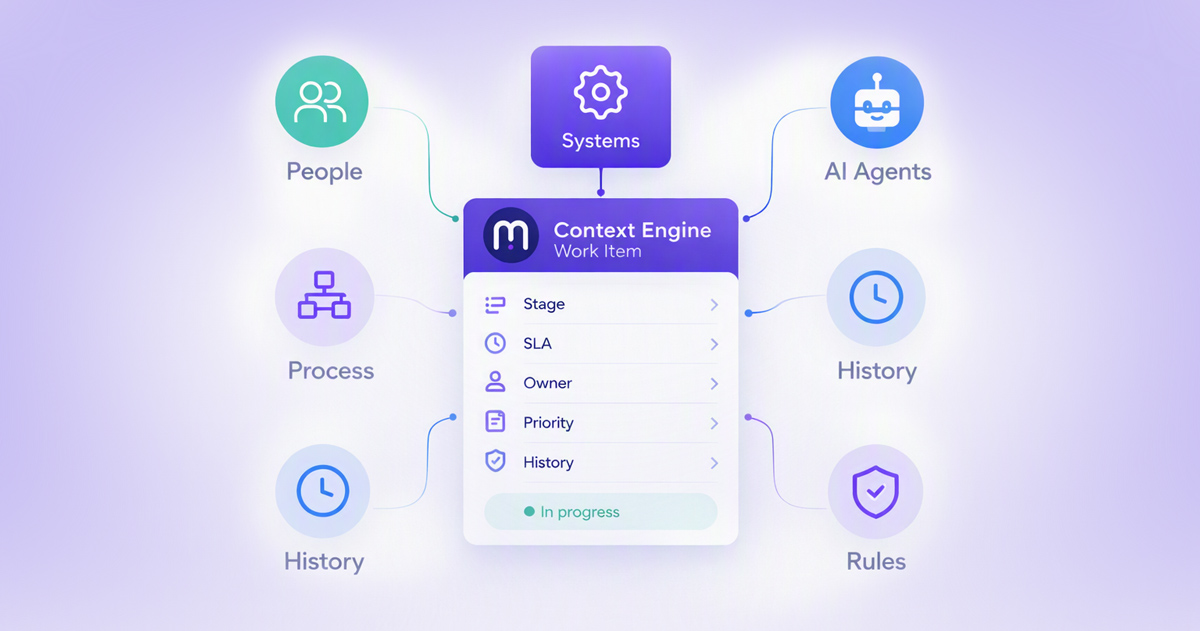
M.’s Context Engine brings together the structure of your organisation, curated knowledge, your processes, live work and the history of how that work has actually happened. Instead of AI operating separately from the business, it can participate within the same environment as your people and systems.
And importantly, you don’t have to start with AI at all.
Start with the work you have today
This is perhaps the bit that gets lost in some of the excitement around AI – you don’t need to wake up one morning and hand your business processes over to a fleet of autonomous agents.
With M., you can start by running work exactly as you need to today, with people completing tasks and M. managing the process around them: the rules, routing, ownership, SLAs, decisions and visibility that keep work moving.
While that happens, something valuable is being created. Every process run adds to the operational context. Every decision, exception and outcome helps build a richer picture of how your organisation works in practice.
So, when you decide that AI could take on part of that process, it isn’t arriving cold, the context is already there.
AI can grow with you
Adopting AI doesn’t have to be a single, dramatic transformation programme, it can, and probably should, be incremental.
Perhaps an agent initially helps someone find information or prepare a recommendation and later, it might complete a defined task. As confidence grows, it could take responsibility for more steps in a process, with people continuing to provide oversight where it matters.
The balance between people and AI can change over time without ever changing the underlying way work is managed and that, for me, is what makes context so important. The future of work won’t be about having more powerful AI, it’ll be about giving AI enough understanding to use its capability well.
The organisations best prepared for that future will likely not be the ones trying to automate absolutely everything today, but may well be the ones making sure that, when they are ready, their AI already understands how their business works.