

For decades, organisations have managed work in broadly the same way.
A request arrives, a process begins, work is assigned to people, systems help move it forward and, eventually, the process reaches its conclusion. Process automation software evolved to support this model, providing structure, automation and visibility across increasingly complex business operations.
For many years, that was enough – today, however, organisations find themselves facing a different challenge.
Artificial intelligence is no longer simply helping people work more efficiently. It is becoming an active participant in business operations. AI can analyse information, generate content, make recommendations and, increasingly, complete work alongside people and other software systems.
In other words, work itself has changed.
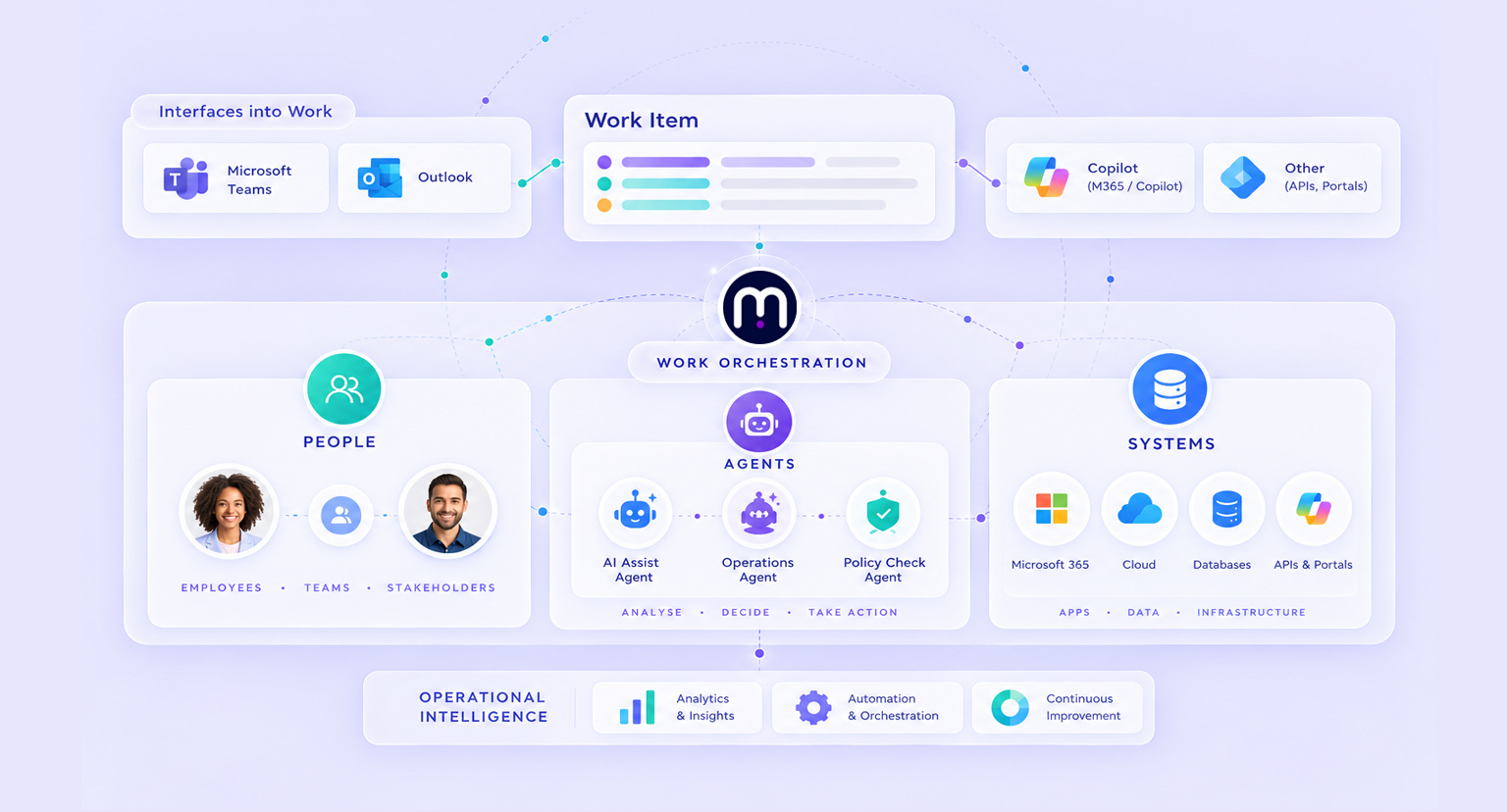
Rather than moving predictably from one person to another, work now flows between people, business systems and intelligent AI agents. Decisions happen in different places, information is exchanged continuously and processes adapt in real time as new context becomes available.
The operating model that supported yesterday’s organisation wasn’t designed for this reality.
Why process automation doesn’t gel with AI
Traditional automation platforms were built around predictable, linear processes. They route work from one stage to the next, automate repetitive tasks and ensure that activities happen in the correct sequence.
Those capabilities remain really valuable and the problem isn’t that process automation has become obsolete. It’s that organisations are now trying to coordinate work involving participants that automation software was never designed to manage.
AI agents don’t simply complete predefined tasks. They interpret information, collaborate with people, interact with multiple systems and make decisions based on context. As organisations deploy more intelligent agents, work becomes increasingly dynamic rather than fixed.That requires something more than process automation, it requires orchestration.
From business process management to work orchestration
Imagine an organisation processing a complex customer request; some decisions require human judgement and others can be completed automatically by business systems. Increasingly, AI agents can analyse documents, prepare recommendations, retrieve information or complete routine activities.
The challenge is no longer deciding whether a person or a system should complete the work, it's coordinating all three.
- Who does what?
- When?
- With what level of authority?
- What happens if an AI agent cannot complete a task?
- Where does human oversight take place?
- How is every decision recorded and governed?
These questions sit above individual workflows as they relate to how work is managed across an entire organisation, and that's where Agentic Work Management begins.
So, what is Agentic Work Management?
Agentic Work Management is an approach to organising, coordinating and governing work across people, business systems and intelligent AI agents. Rather than focusing solely on process automation, it provides the operational framework that enables every participant to contribute effectively while maintaining visibility, accountability and control.
At its heart, Agentic Work Management recognises that organisations are entering a new era where work is no longer performed exclusively by people or software, but through collaboration between both and that changes how organisations need to think about operations.
Instead of asking, “How can we automate this process?”, organisations begin asking, “How should work be orchestrated across people, systems and AI?”. This difference is subtle, but so, so important.
Why now?
Most organisations are already experimenting with AI. Some are deploying copilots, while others are building AI agents or introducing generative AI into specific business processes. Many are investing heavily in Microsoft technologies such as Copilot and Azure AI.
As these initiatives expand, organisations inevitably encounter new questions around governance, visibility and operational control.
- How do we introduce AI safely?
- How do we understand what our AI agents are doing?
- How do we maintain accountability?
- What happens if an AI agent cannot complete a task?
- How do we evolve without replacing the systems we've already invested in?
These aren't just technology questions, they're operational questions and Agentic Work Management provides a framework for answering them.
A gradual path to AI
One of the most important aspects of Agentic Work Management is that it doesn’t assume organisations need to transform overnight.
- Every organisation begins from a different place
- Some are still largely human-led
- Others have embraced automation
- Some are already experimenting with autonomous AI agents
The goal isn’t to leap from one extreme to another. It’s to evolve progressively, introducing AI where it delivers genuine value while ensuring every step remains transparent, governed and aligned with business objectives.
That’s why I believe the future belongs not to the organisations with the most AI, but to those that orchestrate work most effectively.
The next operating model for modern organisations
Every significant technology shift eventually changes the way organisations operate and Artificial intelligence is no different. The challenge isn’t simply adopting AI, it’s creating an operating model capable of bringing together people, systems and intelligent agents within a single, connected way of working.
I believe that operating model is Agentic Work Management, because modern work now demands a fundamentally different approach to managing work itself.
As organisations continue their AI journey, the question will become less about whether they should introduce intelligent agents and more about how those agents work alongside people and existing business systems.
And that’s exactly the challenge Agentic Work Management has been created to solve.