

For much of the last century, work has followed a relatively familiar pattern – people completed tasks, collaborated with colleagues and made decisions. Technology existed to support them, storing information, automating routine activities and helping organisations operate more efficiently.
Every significant advance, from personal computers and the internet to cloud computing and mobile devices, made work faster, more connected and more accessible. Despite these technological leaps, the fundamental operating model remained remarkably consistent; people did the work, systems supported the work. That distinction is beginning to disappear.
The rise of artificial intelligence
Artificial intelligence represents something fundamentally different from the technologies that came before it. It’s not simply another application for employees to use or another system for IT teams to manage, increasingly, AI is becoming an active participant in organisational work. It can analyse information, retrieve knowledge, generate recommendations, prepare documents and complete increasingly sophisticated tasks alongside people.
For the first time, organisations are no longer thinking solely about how technology supports work, they’re beginning to think about how technology contributes to it. This subtle shift has enormous implications.
The conversation surrounding AI often focuses on productivity gains, automation or concerns about replacing jobs. While these debates are understandable, they overlook a much more interesting question.
What happens when every organisation has access to teams made up not only of people, but also of intelligent digital colleagues?
The future of work is unlikely to be defined by organisations choosing between humans and artificial intelligence. Instead, it will belong to those that learn how to combine the strengths of both.
People will continue to provide judgement, creativity, empathy and strategic thinking, while business systems will continue to provide the data, structure and consistency that organisations depend upon. AI agents will increasingly contribute speed, analysis, pattern recognition and the ability to complete work at a scale that was previously unimaginable.
Success won’t come from any one of these capabilities in isolation, it will come from how effectively they work together – and grow together.
Incremental AI adoption is the path to success
As organisations introduce more AI, they quickly discover that adding intelligent agents is relatively straightforward. Coordinating and providing them with the context to help them work best is considerably harder.
Questions begin to emerge around governance, visibility and accountability. Which activities should remain human-led? Which can be delegated to AI? How should work move between people, systems and intelligent agents? How do organisations maintain confidence as this new workforce continues to grow?
These are not questions that traditional automation software was ever designed to answer. They require a different way of thinking about work itself.
The future of work is already taking shape
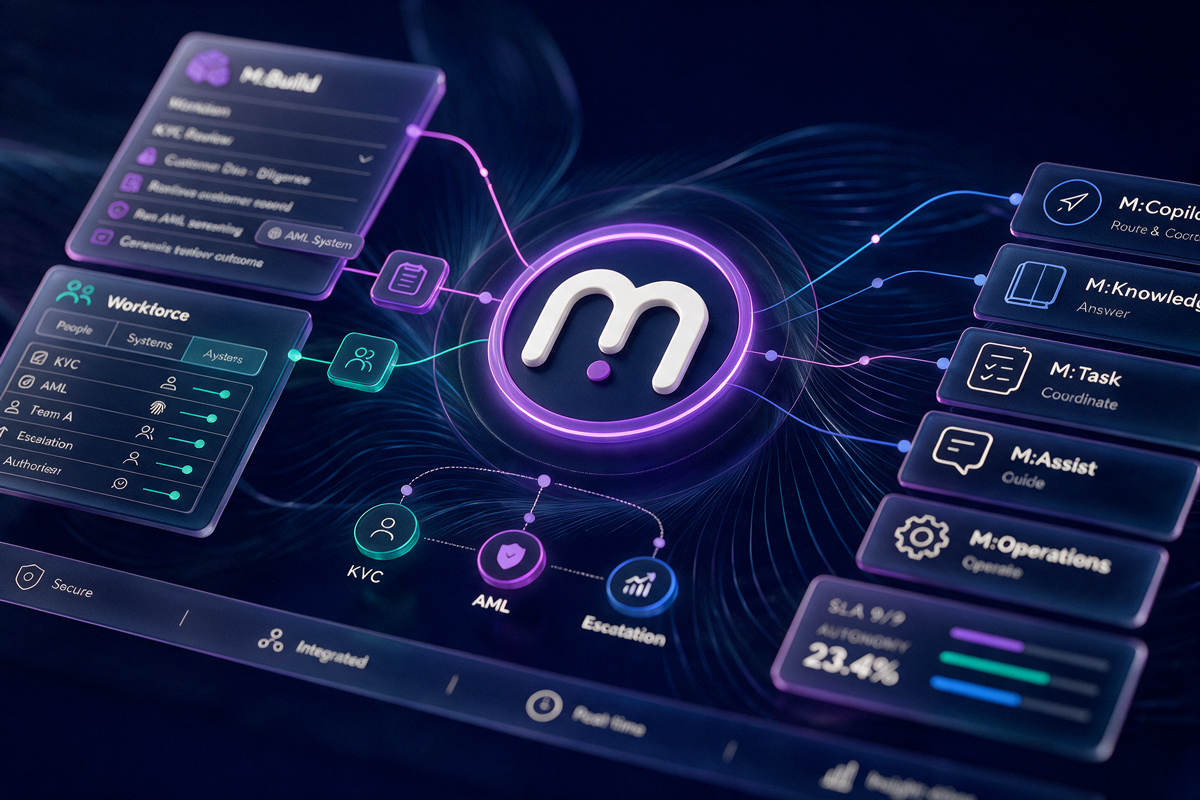
Rather than viewing AI as another tool to bolt onto existing processes, organisations need an operating model capable of bringing together every participant involved in delivering an outcome. One that allows people, systems and AI agents to collaborate intelligently, while maintaining the visibility and governance that modern organisations demand.
This is why we believe the future of work won’t simply be more automated, it’ll be more orchestrated and it’ll increasingly build context and confidence in what agents can do now – and what they will be able to do in the future. Because work itself has evolved beyond the assumptions on which traditional operating models were built.
Every major technological shift eventually changes the way organisations think about work. Artificial intelligence is proving to be no exception. The businesses that thrive over the next decade won’t necessarily be those with the most sophisticated AI, or even those that adopt it first. They’ll be the organisations that build an operating model capable of evolving alongside it, a model that runs on a context engine that incrementally builds the capabilities of the agents working within it.
That's why we believe the future of work isn't something to prepare for someday, it's already taking shape today. And it's exactly why we created M.